Q&A: 937.640.1040
OFFICE HOURS:

Mon–Fri 9:00 AM–5:00 PM (visitors by appt.)
CLOSED Sat–Sun

Login
$0.00 0

Cart

No products in the cart.

“Antique Military” Binoculars

Collectors beware: modern reproductions and outright fakes are increasingly being sold as authentic WWII military optics.

Many high-priced “WWII military binoculars” sold online are actually modern reproductions—or outright forgeries. Drawing on decades of experience restoring authentic military optics and testing thousands of modern instruments, Oberwerk founder Kevin Busarow explains how some sellers are falsely marketing new Chinese-made binoculars as rare Carl Zeiss wartime models. This article shows how to recognize the warning signs of fakes, understand what authentic WWII optics really look like, and avoid spending thousands on misrepresented equipment.


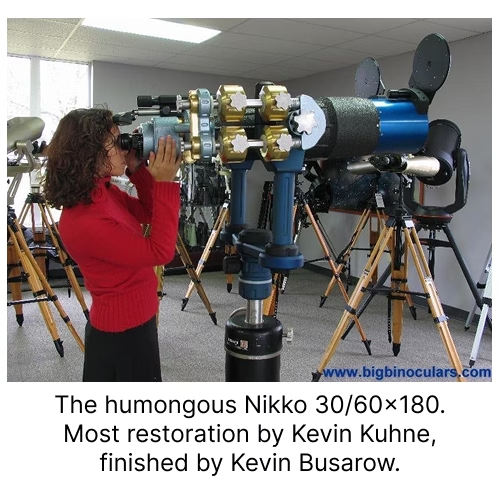
You’ve probably seen the flashy restored WWII binoculars that sell for tens of thousands of dollars from a few online sellers.  Many collectors of these historic instruments consider stripping the original finish from a military antique, then “blinging it out” with chrome and brass plating, to be sacrilegious.   Now I don’t have much of a problem with that- if that’s what you like.  What I do have a problem with is selling modern forgeries as authentic WWII instruments.  As the founder and president of Oberwerk, my business is developing and selling new binoculars using the latest optical technology.  But in my spare time, I’ve restored a number of WWII instruments over the last couple decades.  All but one of my restorations maintained the original finish.  That exception was a monstrous 30-60×180 Nikko, restored by the late Kevin Kuhne in the early 2000’s.  It’s pictured in original unrestored state in Hans Seeger’s Military Binoculars and Telescopes for Land, Sea, and Air Service on pg. 275.  I purchased that binocular from his estate, only to discover later that while it looked great, his restoration wasn’t complete.  In particular, the original 22.5x and 30x eyepieces had been replaced with 30x and 60x- but the eyepiece threading didn’t match the turrets, and the binocular would not come to focus at infinity with those replacement eyepieces.   I was able to correct both those issues and eventually sell it for a modest profit (just over $20,000).  Last I heard, that binocular resides in a Maryland home overlooking Annapolis Harbor.   There is a “bling” example of the 22.5-30×180 Nikko currently on sale at Luxx Optica for an astonishing $995,000!   Dang- I should have kept mine!


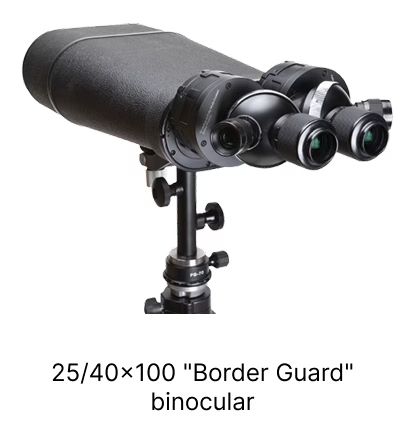
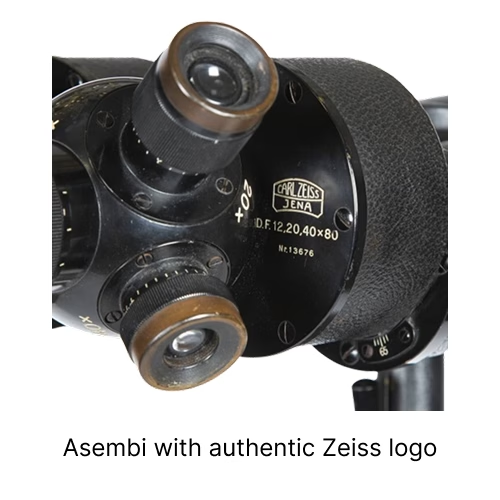
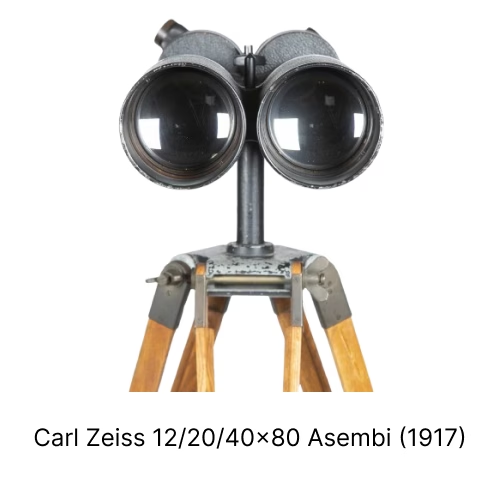
Since it’s founding in 1999, Oberwerk has sold roughly 3500 units of the iconic Chinese-made 25/40×100 “Border Guard” binocular, which was developed the 1960’s.   That binocular was based on the early 1900’s Carl Zeiss Asembi, although there are substantial differences.  The original Asembi had the innovation of three eyepiece pairs mounted on rotating domed-turrets, that provided 12x, 20x, and 40x magnification, through 80mm objective lenses.  The Chinese version had turrets with two eyepiece pairs, 25x and 40x, with 100mm objective lenses.  I’m intimately-familiar with the 25/40×100 as I personally tested and collimated every one of those 3500 units- and I’ve rebuilt dozens that were damaged in falls.   I’m giving you this background so you understand that there are very few people, if any, with more experience with both authentic WWII military optics AND modern Chinese optics, than myself.


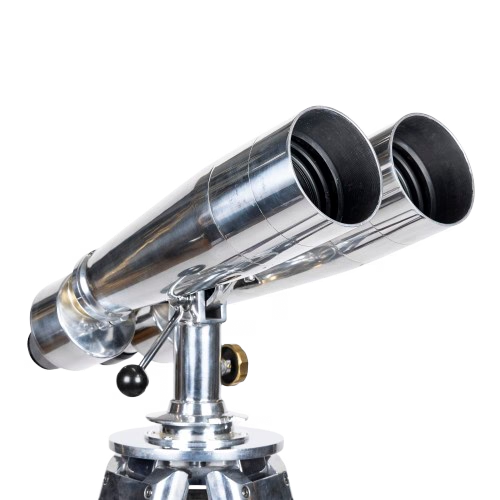
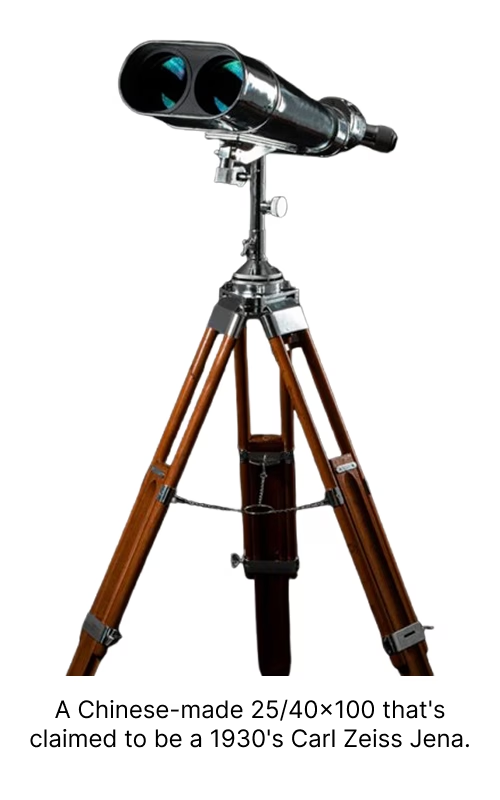
There are several reputable companies out there that sell restored military binoculars, as well as modern reproductions.  In fact, these sellers are mostly selling reproductions, which is understandable as authentic instruments are becoming increasingly-rare (and expensive).   They sometimes are very subtle about the fact that they’re selling reproductions, so read the full descriptions carefully.  These reproductions use the same standard optical glass that is found in most modern binoculars selling for well under $500.  So when you spend thousands for one of these, you’re paying mostly for the bling.  In fact I am also friends with, and work closely with, the person that does most of the restorations for one of more reputable sellers of these blinged-out authentic and reproduction binoculars.  Only one seller (as far as I know) is passing off brand new binoculars as authentic WWII binoculars, and they’re going to great lengths to blatantly deceive.  The Oberwerk 25/40×100 is made in our partner’s assembly plant in Kunming, China.  But because this model has been available in China since the 1960’s, there are other factories in China that can produce the same model.  The main difference is we supply it with our TR3 hardwood tripod, which we build right here in Dayton.  Versions from other Chinese suppliers come with a Chinese-made wooden tripod (that is far inferior to the TR3).  So I was astounded to see that one seller of “authentic WWII military” binoculars is claiming the Chinese 25/40×100, complete with the Chinese tripod, is a “WWII Carl Zeiss Kriegsmarine Binocular”, circa- 1940, country of origin- Germany!

Here’s the full description- This is a rare late 1930’s Carl Zeiss turret binocular offering 20 and 40 times magnification, with 100mm objective lenses. The binoculars have markings of Carl Zeiss. These were the eyes of the Wehrmacht used as radar system to take down the spitfires. These are rare original optics in a distinctly straight-body bulletproof instrument. Undeniably a true piece of artwork , these binoculars offer astounding visual clarity. What you’re seeing are a pair of Silver polished “Carl Zeiss Jena”, the eyepiece turret with locking lever and indications of magnification “20x” and “40x”. WWII Binoculars. Set on a 1930’s military, re-polished Carl Zeiss stand. 
These optics have been originally restored in a time-consuming process to reveal a crystal clear Image. Externally, hand stripping the paint inch by inch and polishing to the modern luster resembling a silver finish.
A stunning centerpiece for any home, office, or yacht, each binocular has its own unique markings, which means no one else in the world except you would own this incredible, one of a kind, collectible piece. 

 

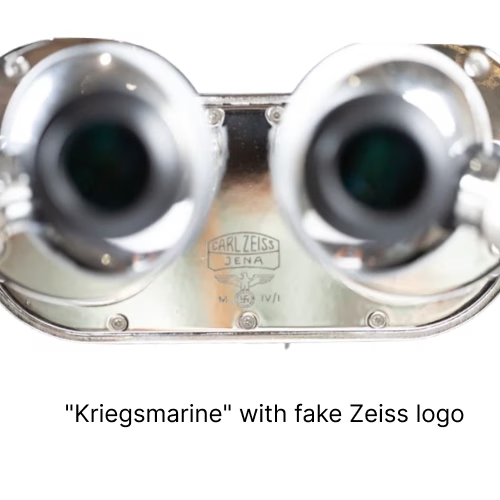
Not only that, but they have engraved the binocular’s backplate with the Carl Zeiss logo, even including a swastika!  To be clear, Zeiss never made a 100mm binocular with turrets, and it should be obvious to anyone doing the least bit of research that the “Kriegsmarine” is 100% a Chinese-made 25/40×100.  It’s sad to see reviews from their customers that think they own authentic WWII binoculars, but in reality were duped into spending a huge sum for a new Chinese-made binocular.  I’m not to going to name this company, but you can figure it out.

UPDATE:  The Chinese-made “Kreigsmarine” mysteriously vanished from that seller’s website shortly after this article was published.


So- how can the buyer, who may not be an optics expert, spot a reproduction, or outright forgery?   Here are a few tips-

  1.  The Price.  Most restored and blinged-out authentic WWII binoculars sell for shockingly-high prices- usually between $12,000 and $100,000.  For the “Carl Zeiss Kriegsmarine” forgery, the “original price” is $18,000- but it’s always “on sale” for just under $9,000.
  2. Optical Coatings.   The Germans started using anti-reflection coatings during the latter part of WWII, and the Japanese didn’t use anti-reflection coatings until well after WWII.  So the vast majority of authentic WWII binoculars have uncoated optics, and reflections off the objectives will be white.  If it’s a early-40’s German binocular, it’s possible that it may have single-coated optics, which show light blue or light purple reflections.  The presence of modern multi-coatings are a dead give-a-way that it’s a reproduction. Modern multi-coatings typically have green-hued reflections (as clearly seen on the “Carl Zeiss Kriegsmarine”).
  3. Google.  Look up the name of the binocular and look for images that either match or differ from the photos of what’s being sold.  You should be able to find restored and unrestored photos, which should make it apparent that what’s being sold matches (or not) your online searches.

Here’s something else to consider.  A restored WWII binocular can be a worthy acquisition for a collector or someone interested in military history- or even someone that just wants something retro and flashy.  But from an optical performance standpoint, technology has come a long way in just the last 20 years, and even the least expensive XL Series Binocular Telescope will optically outperform just about anything from the WWII era- at far less cost.  If distant viewing is your goal, military instruments are relatively-low power- typically 15x to 20x.  Binocular telescopes are capable of up to 56x to 96x, depending on objective size.  One last thing- be aware that antique binoculars rarely come with their original mount, and replacement mounts are sometimes barely serviceable.  If possible, try before you buy.


Oberwerk Corp.
3880 Kettering Blvd.
Dayton, OH 45439

937.640.1040 [email protected]

Join the Oberwerk Family

Subscribe to our newsletter & follow us on social media

©2026 Oberwerk Corporation
POWERED BY

We’ve got you covered.

Shipping Protection gives you peace of mind while saving you time and money.

  • SHIPPING PROTECTION

    Coverage in case your package is damaged in transit, stolen, or doesn't arrive.

  • INSTANT ISSUE RESOLUTION

    Get a refund or replacement in just a few clicks.

  • 24/7 CLAIM SUPPORT

    Route is here for you whenever an issue arises — with an average response time of under an hour.

Don't have an account? Click here to register.

Secret Link