Tripod weight capacity
All tripods have a listed weight capacity that should not be exceeded by the combined weight of the mount and binocular, and it’s always better to be well-under the maximum capacity for a number of reasons. Besides the obvious safety factor, a tripod that is not loaded to its maximum capacity is going to be more stable, have better damping (fewer oscillations after touching or steering the binocular), and will have a steadier view for binoculars that are operating at higher magnifications.
The tripod head is a component that allows steering of the binocular in azimuth (left/right) and altitude (tilt up/down). Some tripods include a head, and some tripods are sold as “legs only” and then matched to a head or some other style of mount. If a head is included with the tripod, it’s important to know the capacity of that head, as it is usually less than the capacity of the tripod legs. For example, the Oberwerk 5000 tripod/head has a 24 lb. weight capacity for the tripod, but the capacity of the head is 14 lbs. Heads can be swapped out if you need higher capacity.
Consider that, unlike a camera, a binocular is often looking upward, which means the load can be very much offset to the rear. This puts much greater stress on the tripod and head than if the binocular was only looking to the horizon, where the load is balanced over the center of the head/tripod.
A head with adequate capacity should be able to hold a binocular at any tilt angle, yet allow steering of the binocular to a new location- without having to readjust drag and lock knobs. An inadequate head won’t be able to hold the binocular at extreme tilt angles without slippage, or without having to lock down the tilt drag to a level where it can’t be steered to a new location without releasing the drag tension.
Tripod construction material
While most tripods are made out of aluminum, some are made out of wood, and carbon fiber is becoming increasingly popular. There are advantages and disadvantages to each of these materials. The advantage for aluminum is its lower cost and lighter weight. Disadvantages are longer damping times and a utilitarian appearance. Advantages for wood are greatest stability, shortest damping times and its classic beauty. Disadvantages are higher cost and heavier weight. Carbon fiber wins for lowest weight. Stability and damping can be highly variable, with cost substantially higher than aluminum, but usually a little less than wood.
Tripod height range
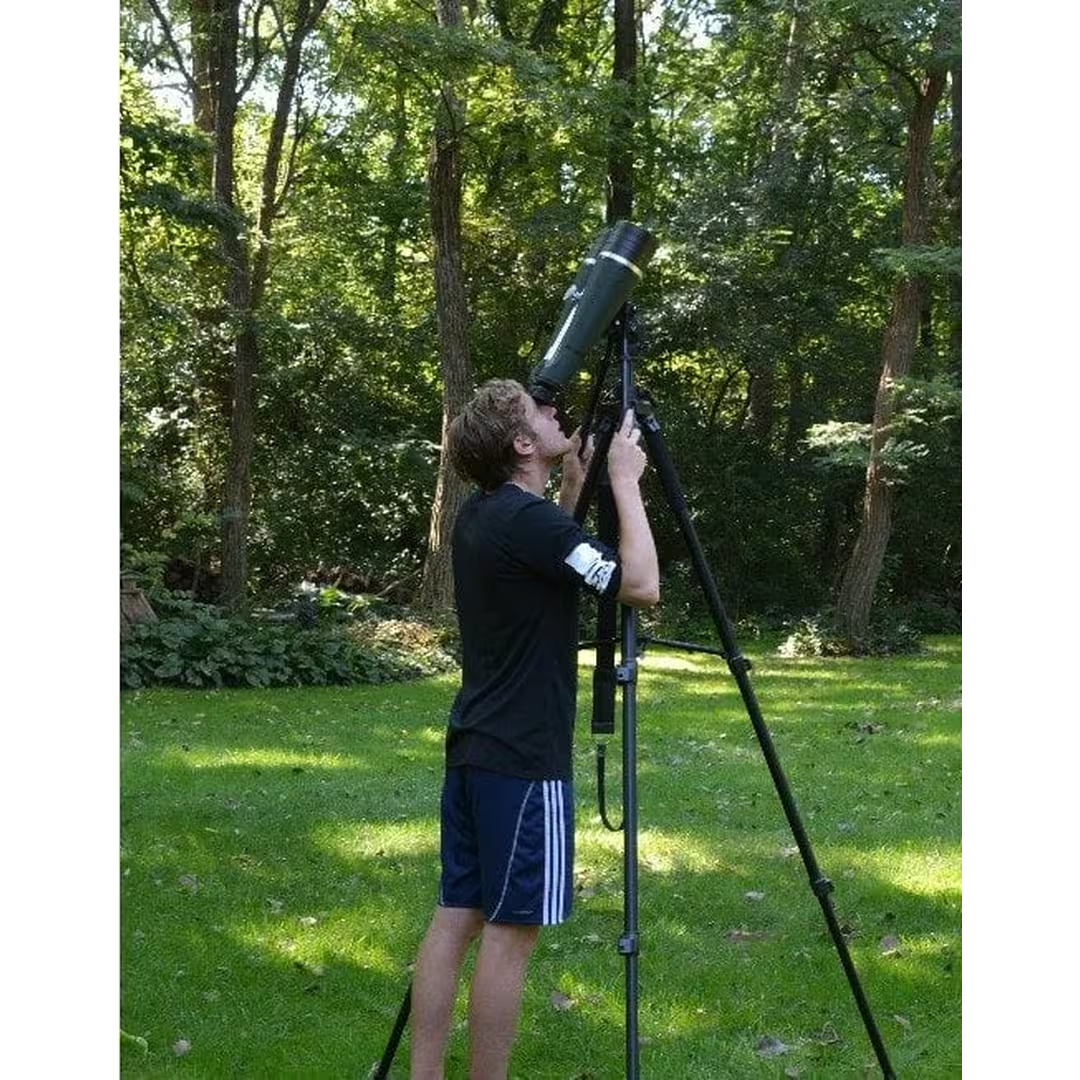
The most overlooked tripod specification is its maximum height. The fact is the vast majority of camera/video tripods on the market don’t have the height required to place a binocular overhead so you can stand underneath the eyepieces and look up at the night sky. Most tripods found in camera stores typically extend to around 60” (5 feet), which is not even enough for most adults to comfortably view to the horizon while standing. Oberwerk’s least-expensive tripod, the model 3000, has up to 78” of height- enough for a 6-foot-plus person to view to zenith (directly overhead) while standing. The Oberwerk 5000 and the TR3 with carbon-fiber elevator will go even higher. Unless you plan to sit while observing, look for a tripod with no less than 76” of maximum height.
Tripod elevators
Many tripods used for binocular astronomy will have an adjustable center column, also called an “elevator”. While the tripod legs can be adjusted in length to obtain the optimum height required for viewing, it takes time to adjust each of the three legs. If height adjusted while a binocular is mounted, only small changes to each leg can be made- otherwise the tripod could become dangerously-unbalanced. It’s much faster and more convenient to change eyepiece height with the use of a tripod elevator. The elevator also adds considerably to the tripod’s maximum height. There are two types of elevators- geared and manual. Geared elevators use a crank handle to slowly raise and lower the elevator. The advantage of the geared elevator is that you don’t have to lift the binocular- simply turn a crank to raise or lower. The disadvantages are you have to lock/unlock the elevator before and after turning the crank, and slow speed due to the multiple cranks it takes to move the elevator through its height range. The manual elevator has the advantage of speed- you instantly lift or lower to your desired height. The downside is that you are momentarily holding the weight of the binocular and mount with one hand as you operate the elevator lock mechanism with the other hand. For this reason, a manual elevator is not recommended for our largest binocular telescopes (110XL, 120XL, and 127XL). The Oberwerk 3000, 4000, and TR3 use manual elevators. The Oberwerk 5000, Manfrotto 475B and 161MK2B have geared elevators. Regardless of type, using an elevator at its maximum extension can add a degree of instability, so avoid that if possible. It’s always best to obtain as much height as possible from the tripod legs, then use the elevator for any additional height that may be needed between multiple people viewing, and/or to handle the difference in eyepiece height when viewing different elevations of the night sky.
Tripod Heads
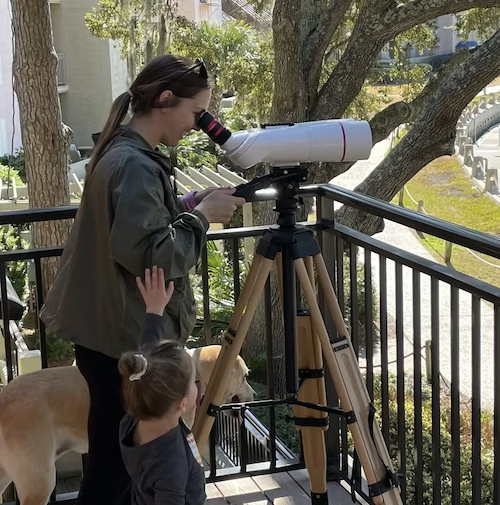
When mounting a binocular, there are different considerations than when mounting a camera. While 360-degree ball heads are commonly used for cameras, they’re generally not recommended for binoculars as you need to be able to move in small controllable increments, and keep the eyepieces level. As a binocular tilts back to view upward, it becomes increasingly-difficult to control small movements with a ball head, and keep it level, especially as that weight becomes very offset. It’s much easier to use a camera or video camera head, which will always keep the eyepieces level. Set the altitude (tilt) drag (tension) so that the head will hold the binocular at any tilt angle, but easily allow the binocular to be steered to a different tilt angle using the leverage of the panning handle(s). For binocular usage, tripod heads are often configured with dual panning handles. This makes steering easier, especially so when the binocular is tilted back to zenith (directly overhead), where there may be considerable drag applied to prevent the binocular from slipping backward. Did you know that all heads reach zenith in only one direction? This means that to view to zenith, the head must be used “backwards” from what the manufacturer intended. This means the panning handle(s) must attach at the front of the head and run toward the back (toward the observer). The other advantage of using a head backwards, besides being able to reach zenith, is that the panning handles don’t protrude as far to the rear, allowing the observer to get close to the eyepieces without interference.
Fork Mounts
Fork mounts are an alternative to tripods heads, and can be a lower-cost option for heavier binoculars that would otherwise require expensive heads with higher weight capacity. They are sturdy, well-balanced, and very simple to operate, with altitude (tilt) drag as the only adjustable control. The downside is they are bulkier and heavier than tripod heads, so they may not be the best choice for portability.
Parallelogram Mounts
Parallelogram mounts are a great choice when people of different heights are sharing the view through a binocular, especially when looking up at the night sky. The moving parallelogram design of the mount allows the binocular eyepiece height to be raised or lowered within a two-foot range- without losing the target object in the view. Because the binocular is in perfect balance, it “floats” in front of you, and you can effortlessly steer it to any target in the night sky. Oberwerk offers the PM2 parallelogram mount, which pairs perfectly with the TR3 tripod (both are built from solid maple or walnut at Oberwerk’s facility in Dayton, OH).
The downside is they are rather expensive, bulky, and heavy due to the use of counterweights. But for certain situations, such as showing a long line of people a view of Saturn at a star party- there’s no better choice. For that reason, a number of astronomy clubs own a PM2. SpaceX has a very specialized daylight use of parallelogram mounts- they use two Oberwerk 100XL-ED’s, each mounted on a PM2/TR3, to view launches and landings at Starbase, TX.
“Go-To” Mounts
For those looking for the easiest way to tour the night sky, computerized go-to mounts are a very compelling option. These mounts automatically locate and track celestial objects across the night sky. We carry iOptron HAZ mounts, which are “alt/az” mounts, meaning they track in both azimuth and altitude simultaneously in order to always keep the binocular’s eyepieces level.
Unlike previous generations of computerized mounts, the new HAZ mounts use “strain-wave” technology, which means they don’t need counterweights to balance the load. They’ll handle even our largest binocular telescopes with ease, which makes for easy setup and greater portability.
HAZ mounts include a hand-controller, which contains a catalog of over 200,000 night sky objects. Just choose the object you’d like to observe, and the mount will find it. It has built-in GPS, so there’s no need to perform a polar alignment. Simply run the setup routine, which takes just a minute or two, at which point it knows how to find any object in the night sky. Not only that, it will automatically track that object, compensating for the Earth’s rotation. This is particularly helpful for long observation sessions or when sharing the view with others, since the target object remains centered in the eyepieces indefinitely. The only downside, besides the relatively-high cost, is that the binocular can only be moved by the mount’s motors, using the hand controller. But the hand controller has buttons for up/down/left/right, and speed settings from 1 through 9, so even for daylight viewing, it’s easy and rather fun to use.